
Unseen Enemies
Depictions of Abstract Violence in European Painting

Introduction
European painting has served as a powerful medium for confronting not only physical violence but also subtler forces that destabilize societies. Beyond the visceral spectacle of brutal battle scenes, artists have deployed their skills to expose ideological oppression, political corruption, and the dehumanizing impact of modernity, using symbolic and often satirical representations. These works of art illuminate unseen enemies that fuel destabilizing conflict. They offer deep social and political commentary that continues to provoke critical discussion.
This essay will examine three seminal works—Honoré Daumier’s The Legislative Belly (1834), Edvard Munch’s The Scream (1893), and George Grosz’s Pillars of Society (1926)—that demonstrate how European artists have harnessed art to critique the psychological, systemic, and ideological conflicts that shaped their times. Transcending literal depictions of violence, these artists invite a deeper understanding of the forces that belie political conflict. Together, they reveal the enduring role of art as a mirror of modern society’s anxieties.
Historical and Artistic Context
To appreciate the works of Daumier, Munch, and Grosz, it is essential to situate them in their historical and artistic contexts. In 19th-century France, political satire and caricature emerged as a potent response to the consolidation of social power and the lingering traditions of monarchical rule. During the July Monarchy (1830–1848), a period of economic disparity and political complacency, artists like Daumier made effective use of lithographic printing to disseminate sharp critiques of social injustice and government corruption. The era’s satirical art exposed the failures of the ruling elite to address the needs of the population, reflecting public discontent with systemic inequities (Carroll 2008, 128–130).
As the 19th century gave way to the 20th, the advent of Symbolism and Expressionism in Europe’s art world marked a shift toward exploring psychological and existential themes. Rapid industrialization, urbanization, and the erosion of entrenched social structures fostered widespread anxiety about modernity’s impact on European civilization. Symbolist artists evoked inner emotional states through suggestive imagery; Expressionist artists amplified these concerns through distorted forms, vivid colors, and highly emotive compositions. Artists working in these styles sought to express the alienation and disorientation experienced by individuals in an increasingly mechanized and fragmented world. They sought to capture the real psychological toll of societal transformation (Pinkus 2021, 45–47).
By the early 20th century, the cataclysm of World War I and the political instability of the Weimar Republic (1919–1933) gave rise to new and radical artistic movements such as Dada and the New Objectivity movement in Germany. Artists employed biting satire and fragmented aesthetics to critique the hypocrisies of nationalism, militarism, and the nascent fascist ideologies of the period that were threatening democratic ideals. These movements rejected conventional artistic norms, embracing irony and provocation to expose the decay of authority structures and the dangers of ideological extremism. By challenging societal complacency, artists sought to awaken their audiences to the forces undermining social cohesion (Carroll 2008, 189–191).
Honoré Daumier, The Legislative Belly (1834)
Honoré Daumier, a prolific caricaturist and painter, was a leading figure in 19th-century French satire, known for his critiques of political and social corruption. Working during the July Monarchy, Daumier faced strict censorship laws but persisted in using his art to expose the complacency and moral failings of the political elite. His lithograph The Legislative Belly (1834), published in the satirical journal La Caricature, exemplifies his mastery of visual satire, transforming the mundane setting of a parliamentary session into a scathing indictment of a corrupt political system.
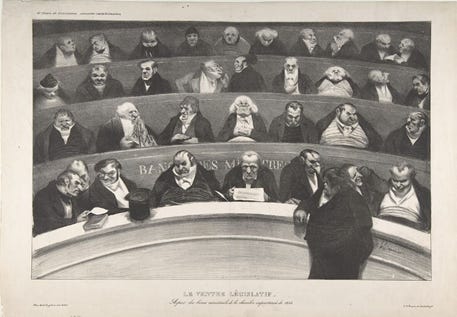
The Legislative Belly depicts bloated, drowsy politicians slumped on ministerial benches of the French Chamber of Deputies. Daumier’s embellished, grotesque figures, characterized by sagging postures, heavy jowls, and vacant expressions, convey sloth, arrogance, and indifference. The composition’s heavy shading and bold lines amplify the caricatured forms, creating a wider visual metaphor for moral decay.
Indeed, the lithograph’s subtitle, “Aspect of the Ministerial Benches of the Improstituted Chamber of 1834,” reinforces Daumier’s accusation that the political class betrayed public trust through their corruption and inaction. As Margaret Carroll argues, “The obese, uninspired, drowsing figures in this lithograph embody the sloth, arrogance, and corruption Daumier associated with the monarchy and its supporters” (Carroll 2008, 132).
The work reflects political tensions of the July Monarchy, a regime that promised liberal reform but ultimately prioritized wealthy class interests. The effect was to exacerbate social inequalities. Daumier’s satire targets the violence of a government that perpetuates injustice through neglect, exposing divisions between ruling elites and the working class. By rendering politicians in this grotesque manner, he challenges not only their individual failings but also the broader political system that enables their selfish complacency. And the lithograph’s accessibility, facilitated by mass printing techniques, ensured that its message reached a popular audience, amplifying its impact. Daumier’s work serves as a visual manifesto, urging viewers to recognize the harm wrought by corrupt governance.
Edvard Munch, The Scream (1893)
Edvard Munch, a Norwegian painter and printmaker, is celebrated for his expressive representations of emotional and existential turmoil. Shaped by the personal tragedies that marked his life, such as the deaths of his mother and sister, and the cultural anxieties of the late 19th century, Munch’s work captures the feelings of psychological disquiet that accompany modern life. His iconic painting The Scream (1893) is a haunting depiction of existential dread, a visual embodiment of the feelings that torment individuals and society in times of profound change.
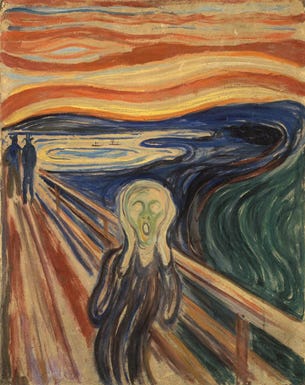
The Scream features a solitary, androgynous figure on a bridge, hands cupped around its face in a gesture of horror. The figure’s distorted features, the wide, hollow eyes, open mouth, and skeletal form, convey a sense of anguish. The swirling, blood-red sky and turbulent landscape evoke a world of chaos. Munch’s use of unnatural colors and undulating lines creates an immediate sense of emotional intensity, immersing his audience in the figure’s psychological torment. The painting’s composition, with its diagonal bridge and unexplained receding figures, enhances the sense of personal and emotional isolation, reinforcing the central figure’s alienation from its surroundings. As Assaf Pinkus explains, “The horror to which he sensitizes the eyes and ears of the viewer with this picture reflects the fears of the individual and at the same time captures the madness of an era that was heading for an abyss” (Pinkus 2021, 67).
Created at the dawn of the imperialist era, The Scream reflects the anxieties of a world grappling with industrialization, urbanization, and colonial expansion. These forces disrupted traditional social structures, creating a new and pervasive sense of alienation. Munch’s painting transcends personal experience to articulate a growing fear of modernity’s dehumanizing impact, of the psychological violence impacting those who live in the new incomprehensible world. The figure’s scream is not a response to a tangible threat: it is a visceral expression of internal conflict, which resonates with viewers who in their own lives are also experiencing existential crisis. Munch anticipates the ideological and psychological conflicts that would later define the 20th century, positioning The Scream as a prophetic reflection on the modern condition.
George Grosz, Pillars of Society (1926)
George Grosz, a major figure in the Berlin Dada and New Objectivity movements, used his work to expose the corruption and hypocrisy of Weimar Germany. Working in the aftermath of World War I, Grosz’s targets were the political, religious, and wealthy elites whose actions contributed to societal decay and the rise of the Nazi state. Grosz’s painting Pillars of Society (1926) is a ferocious critique of the systemic and ideological violence perpetuated by Weimar political figures. It is a historical representation, but also a prophetic warning about the gathering danger of unchecked political power.
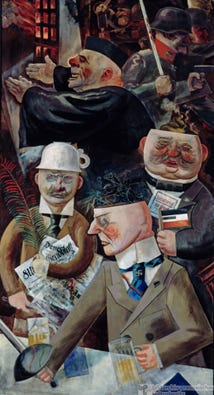
Pillars of Society depicts a chaotic, dystopian scene of grotesque characters: a politician with a pile of excrement for a brain, a clergyman clutching a cross and a beer mug, a soldier brandishing a sword, and a journalist spewing propaganda. Grosz’s use of angular, jagged lines, brash colors, and distorted forms creates a sense of confused fragmentation, a mirror of the instability that weakened Weimar society. The painting’s crowded composition and overlapping figures suggest a world teetering on collapse; its ironic title exposes the hypocrisy of the so-called “pillars” who undermine rather than sustain societal stability. As Carroll writes, “Through his artworks, Grosz laid bare the corruption, hypocrisy, and moral decay that he perceived within the pillars of society, namely the political establishment, the clergy, and the military class” (Carroll 2008, 194).
The political context of the Weimar Republic shapes Grosz’s critique, for that was a period characterized by economic crisis, polarization, and the growth of extremist ideologies. The painting thus condemns societal institutions as complicit in creating conditions for violence and oppression. It reminds viewers of the role of propaganda and militarism in fostering authoritarianism. And by depicting the ideological corruption of Weimar leaders, Grosz exposes the dangers driving political violence and physical conflict. Grosz’s work stands as a call for resistance against the catastrophic consequences of ideological extremism.
Comparative Analysis
These works by Daumier, Munch, and Grosz, though distinct in their historical moments, share a commitment to expose unseen enemies of modern democratic society—political corruption, psychological anxiety, and ideological oppression—through symbolic and satirical representations. Each adapts their visual language to confront these threats, a reminder of the enduring potential of painting as a medium for social and political criticism.
Daumier’s The Legislative Belly employs the sharp, reductive forms of caricature to critique the systemic violence of political inaction during the July Monarchy; his exaggerated depictions of bloated politicians as grotesque figures are a pointed indictment of corruption and complacency, reflecting the dividing lines between ruling elites and working classes. Indeed, the work’s wide accessibility, made possible by advances in lithographic printing, allowed Daumier to reach a mass audience with his critique. This commentary on the abuse of power is in fact a direct intervention in democratic discourse.
Munch’s The Scream uses Expressionist techniques to explore the psychological violence of modernity. He captures the existential dread of an individual overwhelmed by an alienating world; the painting’s distorted forms, vibrant colors, and surreal composition evoke a universal sense of crisis, transcending a specific event to address broader anxieties of an era of industrialization and social upheaval. Unlike Daumier’s focus on tangible institutional failures, Munch’s work delves into the internal or psychological struggles that define the human experience.
Grosz’s Pillars of Society bridges the satirical approach of Daumier with the emotive intensity of Munch, using a proto-Expressionist style to critique the ideological violence of Weimar Germany. Like Daumier’s work, Grosz targets specific societal figures: the politicians, clergy, and journalists. But his fragmented, distorted scene aligns with Munch’s exploration of psychological or existential dread. The painting’s chaotic composition links political oppression with authoritarian rule and societal decay.
These works illustrate how artists have adapted their craft to confront subtle forms of violence, from political intransigence to existential anxiety to ideological extremism. Their shared commitment to symbolic representation, through caricature, metaphor, or irony, underscores the power of visual art to reveal provocative truths that are often obscured. By engaging with these paintings, viewers are challenged to recognize unseen forces that shape societal conflict and to reflect on their own role in addressing them.
Conclusion
Through distinct visual languages, Daumier, Munch, and Grosz render visible the forces that destabilize modern societies: political corruption, psychological disintegration, and ideological distortion. These are not incidental features of their respective eras but recurrent conditions that operate beneath the surface of organized social life. By moving beyond literal depictions of violence, their work exposes the mechanisms through which conflict is produced, sustained, and normalized.
The enduring force of these images lies in their refusal of distance. They do not present violence as an external event, but as something generated within the structures of governance, perception, and belief. In Daumier, it appears as the inertia of power; in Munch, as the internalization of anxiety; in Grosz, as the visible collapse of institutional legitimacy. Each, in different form, reveals a society already under strain.
These works persist because the conditions they diagnose persist. The languages have changed—political spectacle, technological mediation, ideological fragmentation—but the underlying tensions remain. The function of these images is not to warn or reassure, but to clarify. They make visible what is ordinarily obscured, and in doing so, they return the problem of violence to the structures that produce it.
Works Cited
Carroll, Margaret. Painting and Politics in European Art. Pennsylvania State UP, 2008.
Pinkus, Assaf. Visual Aggression: Images of Violence in Late Medieval Germany. Pennsylvania State UP, 2021.
Image Credits
Figure 1. Honoré Daumier, The Legislative Belly (1834), lithograph, originally published in La Caricature. Source.
Figure 2. Edvard Munch, The Scream (1893), oil, tempera, and pastel on cardboard, National Gallery, Oslo. Source.
Figure 3. George Grosz, Pillars of Society (1926), oil on canvas, Neue Nationalgalerie, Berlin. Source.